
Companies House is introducing major changes to how company directors and people with significant control (PSCs) prove their identity.
The changes are part of the Economic Crime and Corporate Transparency Act 2023 and are designed to improve the accuracy and reliability of the Companies House register and reduce the use of companies for fraud and other illegal activities.
From 18 November 2025, identity verification became a legal requirement, with a 12-month transition period for existing directors and PSCs to complete the process.
If you own or run a UK limited company, it is important to understand what the new rules mean and when you need to take action.
What Is Changing at Companies House?
Historically, Companies House generally accepted information submitted to the register without independently verifying the identity of the person being registered.
The new system introduces mandatory identity verification. The current requirements apply to:
- Company directors
- People with significant control (PSCs)
- Authorised Corporate Service Providers (ACSPs), such as accountants and company formation agents
Companies House is introducing identity verification requirements for some other roles in later phases.
The purpose of these changes is to reduce fraud and improve the transparency, accuracy and reliability of the Companies House register
_1790841807.png)
When Did the New Rules Start?
18 November 2025 was an important date.
From this date:
- Identity verification became a legal requirement.
- New directors and PSCs became subject to verification requirements.
- Companies House began the 12-month transition period for existing directors and PSCs.
- Identity verification became part of the incorporation and appointment process for new directors and PSCs.
However, 18 November 2025 was not a single deadline for every existing director and PSC.
Existing individuals have different deadlines depending on their circumstances.
Companies House provides the relevant verification period through its online services.
Who Needs to Verify Their Identity?
If you are a director of a UK company, you will need to verify your identity.
The requirement also applies to People with Significant Control (PSCs).
A PSC is generally someone who owns or controls a company—for example, an individual who owns more than 25% of the shares or voting rights, or otherwise has significant control over the company.
The requirements currently apply to company directors, PSCs and Authorised Corporate Service Providers (ACSPs). Companies House is introducing requirements for some other roles in later phases.
How Does Companies House Identity Verification Work?
There are two main ways to verify your identity.
Verify Directly With Companies House
You can verify through GOV.UK using GOV.UK One Login. Depending on your circumstances, identification may include a biometric passport or UK photo driving licence.
Use an Authorised Agent
You can also ask an Authorised Corporate Service Provider (ACSP), such as a registered accountant, solicitor or company formation agent, to verify your identity.
Once verification is complete, you will receive a unique Companies House personal code.
What Is a Company's House Personal Code?
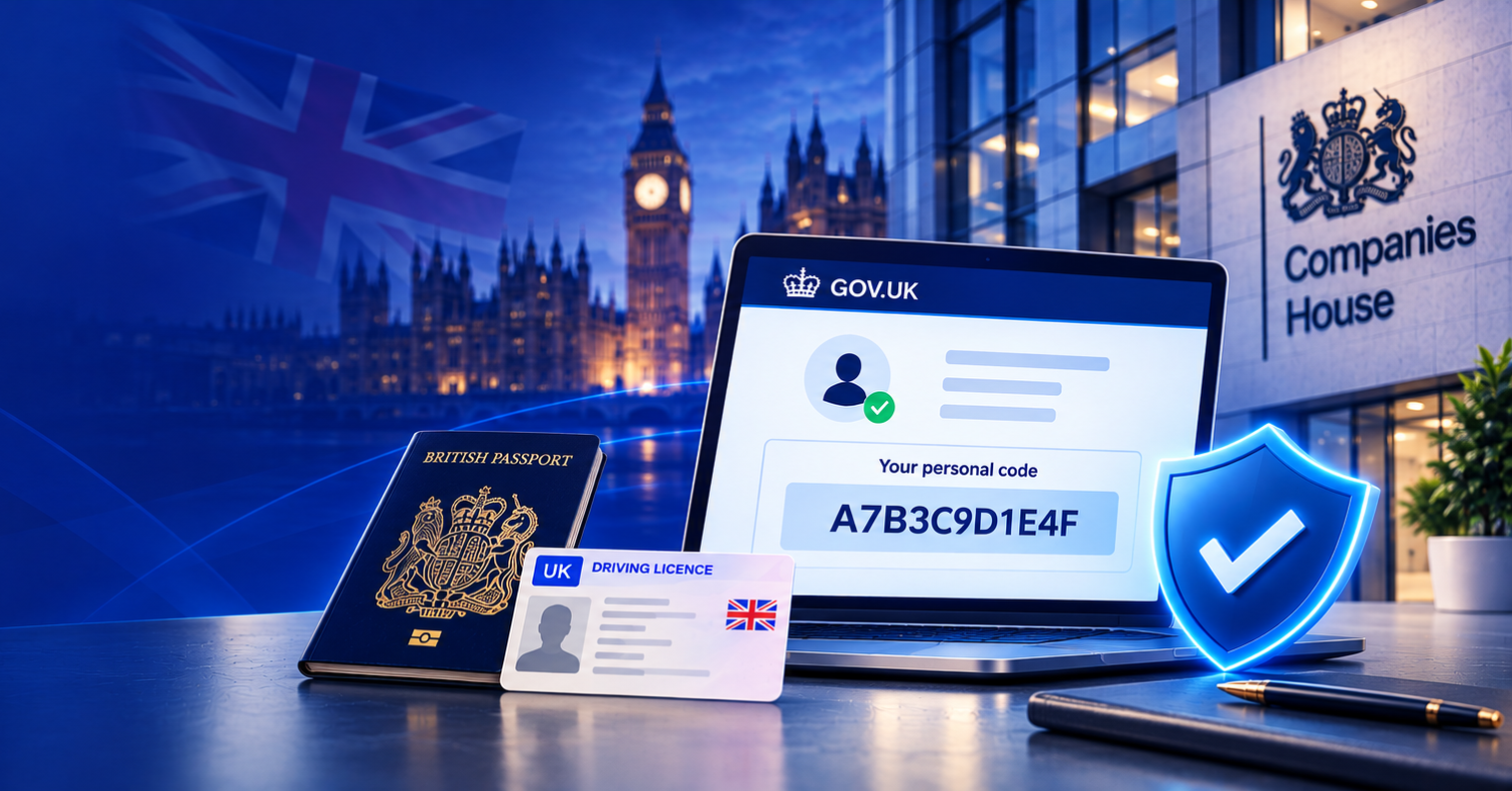
After you successfully verify your identity, Companies House gives you an 11-character personal code.
Think of this as your personal identifier for Companies House verification.
It is used to connect your verified identity with the companies where you are a director or PSC.
Your personal code is important.
You should keep it secure and only provide it to people you trust who need it for legitimate Companies House filings.
What Happens If You Do Not Verify Your Identity?
This should not be ignored.
Identity verification is now a legal requirement.
Companies House states that if a director continues to act as a director after their applicable deadline without complying with the identity verification requirements, they may be committing an offence.
Failure to comply can result in enforcement action, and Companies House may display a note against the individual's name on the public register. Financial penalties or fines may also apply.
The important point is:
This is not simply an optional Companies House administration exercise.
It is a legal requirement.
What Should Company Directors and PSCs Do Now?
If you are a company director or PSC, you should:
1. Check whether you have completed identity verification
Do not assume that your previous Companies House login or filing history means you have already been verified.
2. Complete the verification process
You can verify directly through Companies House or use an Authorised Corporate Service Provider (ACSP).
3. Keep your Companies House personal code secure
You will need this code to connect your verified identity with the relevant Companies House records.
4. Check your deadline
Existing directors generally provide their personal code through the relevant Companies House process, while PSCs have a specific 14-day period to provide their personal code and verification statement, depending on their circumstances.
5. Check your company record
Make sure your director and PSC information is accurate and up to date.
6. Speak to your accountant
If your accountant is registered as an ACSP, they may be able to complete the identity verification process for you.
How 4Future Accountancy Can Help
At 4Future Accountancy, we help limited-company directors and PSCs understand and manage their Companies House requirements.
Our support can include:
- Companies House identity verification support
- Director and PSC compliance
- Confirmation statements
- Companies House filings
- Company incorporation
- Ongoing company secretarial support
If you are unsure whether you need to verify your identity, contact 4Future Accountancy before your Companies House deadline.